A Letter To The Newly Diagnosed
From one breast cancer sister to another, a note of encouragement about your options
by Kelsie Barnhart
@kelsiebarnhart
Sister ―
For your sake and mine, I wish we were meeting under different circumstances ― perhaps striking up a conversation in line at a coffee shop because I like your shoes or you notice my tattoo. Or a world in which you lend me a magazine on an airplane or we are invited to a game night by a mutual friend. Instead, we are part of a club that no one asks to join: the breast cancer club. I wish we weren’t sisters in this fight but we are.
When I joined the club at age 27, a doctor with very kind eyes informed me that my cancer spanned four inches by five inches and my only surgery option was a modified radical mastectomy. As shocked as I was to learn that something hostile had been growing within the presumably healthy confines of my body, I was more startled by the amount of life-changing decisions that needed to be made quickly. You have also felt the unexpected burden of a word most people fear to hear and swallowed that first pill ― the news itself. Yet the pace of treatment does not slow down for our processing.
In the same conversation as my diagnosis, my care team scheduled a slew of appointments for my first two weeks and I started to ride the rollercoaster of oncology, imaging, surgery, radiology, nutrition, fertility, and plastic surgery. It didn’t take very long with any of the well meaning medical professionals to ascertain their assumption that I would have reconstruction.
But the more patients I connected with in person and online, the more I began to see that breast reconstruction was an option for us and not a required part of the medical plan. Thankfully, no one in my close circle of support was treating it as an easy choice to make and they validated the questions I was asking myself just as I validate those that you might be working through now.
Would having reconstruction help me feel more at home in my post-mastectomy body?
Did I want a foreign liquid or gel object implanted in my body?
Was the list of possible complications something I could accept?
Would wearing a prosthetic interfere with my life and favorite hobbies?
It's about positive self-image
Medical breakthroughs come in various forms and it became more and more evident to me that a positive body image and a grounded sense of womanhood could come from reconstruction or going flat alike. I ultimately opted for the choice that would help me avoid future surgeries, but I wasn't very optimistic about the impact the decision was likely to have on my self-image.
Then I was fitted for my first Amoena prosthetic three months after surgery. Despite an underlying feeling that this reality was still not supposed to be my life, I was instantly impressed by the variety of sizes and shapes alongside the quality of the materials. And knowing a subset of the medical community was putting real time and energy towards creating breast forms with a natural feel felt like such a personal gift. It was as if the kindness of the store clerk and the personalized nature of the prosthetic whispered, “You’re still you. You’ve made it this far and you can keep going.”
It is six years later and I still wear an Amoena prosthetic almost every day.
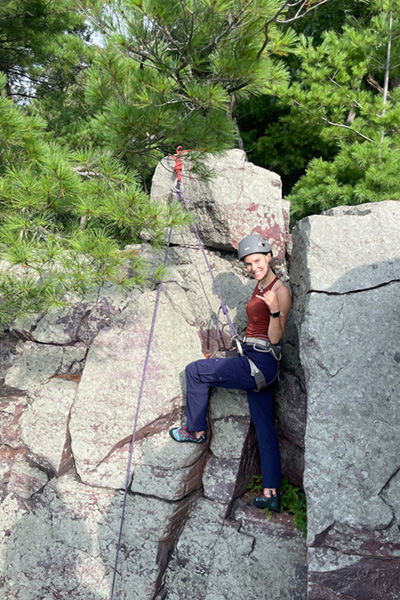
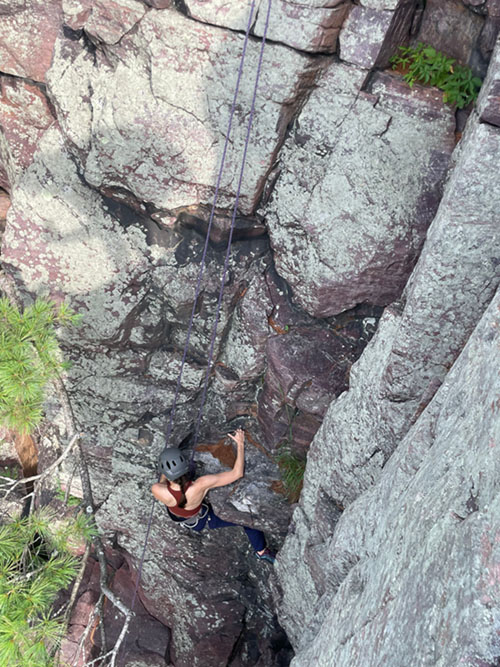 From touring an archaeological site in Mexico to rock climbing the quartz cliffs of Wisconsin, I get to decide on any given day if my prosthetic will help me feel more comfortable in my outfit and more at peace in this body. I am continually thankful when I get ready for my day with the Contact Form and I know I can participate in the life I want to live without movement limitations or self-consciousness. I can do the Warrior Three pose at outdoor yoga in a racerback exercise top. I can push through the multi-hour hike with an epic view for lunch at the top and the prosthetic will not move. I can be as active as I want to be, without worrying that an implant will move, rupture, or reach its lifetime and need to be replaced.
Secure in my body
Over the years, I have grown more secure in my body with or without a prosthetic ― a body that bears a seven inch scar but has made it through a trauma it never expected to face. And yet, having the daily option to add an accessory that helps me carry the mental load of this experience harkens back to that original whisper, “You’re still you. You’ve made it this far and you can keep going.”
According to the World Health Organization, countries that have succeeded in reducing breast cancer mortality have been able to achieve an annual breast cancer mortality reduction of 2-4% per year (source). Survival efforts require the world’s attention. But I believe, for you and for me, equally as important is the experience of survivorship itself. We must understand our treatment options in order to make the decisions, whatever they may be, that will hold us up on this road.
And though the road is long, it is my hope that as you look in the mirror, you are proud of what your body has survived. That confidence pours forth when you remember that the news of your body’s frailty is not the end of your story. That as you face each decision one at a time, you follow your gut and you stand firm on what you know about yourself. And finally that you remember the road is not empty, but rather it is full of other club members, other fighters, and other sisters.
 |  |
Related: Barbara's Decision to Wear Breast Prostheses